How do you take group bookings without losing the evening?
Group bookings are the most resilient demand of 2026, and the most fragile. How to take large parties without long phone calls or an empty room.

Amelia Cooper
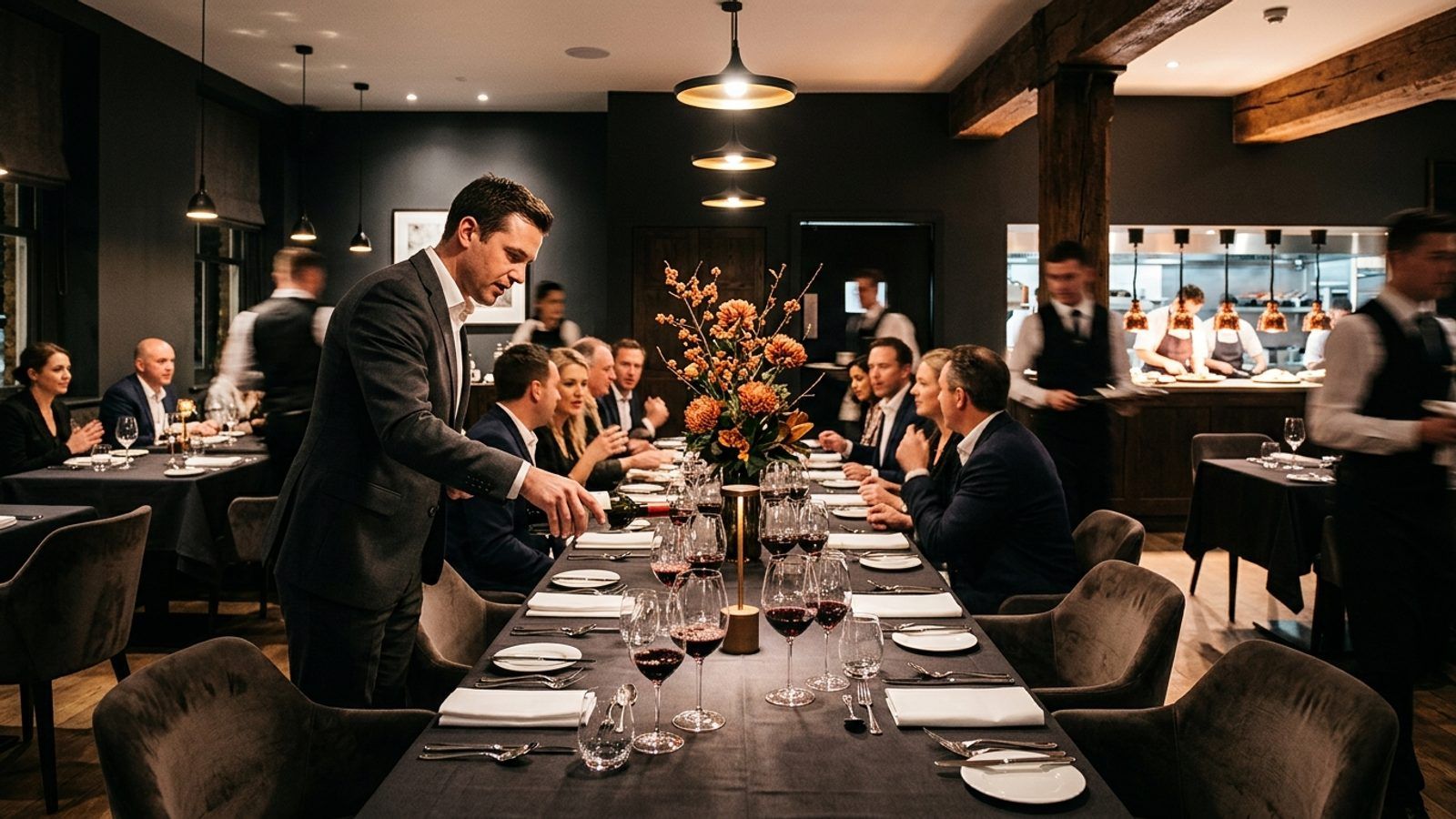
The last fortnight of August is quieter on the phone than the fortnight before it, and that lull is the moment the year-end group season actually opens in France. Companies fix their date for the repas de fin d'année in September. Associations, families and clubs book their autumn dinners in the same weeks. The restaurants that end up with a full December are rarely the ones that were better in December; they are the ones that were easy to book in September. That is worth knowing now, because a table of ten is both the most valuable booking in your book and the one most likely to cost you an evening.
Why are group bookings worth chasing in 2026?
Because they are holding up while other demand wobbles. Across 2026, reservations for parties of six or more have been one of the steadier signals in the sector, at a time when solo covers and couples are more sensitive to what people are spending. A group is a decision made once, weeks ahead, by someone who has already committed to the occasion, so it does not evaporate because the weather turned or the household budget tightened that week.
The economics are better too, and not only because more people sit down. Groups usually eat a set or reduced menu, which the kitchen can prepare against, so food cost is more predictable and the pass is calmer. They order more wine per head than a table of two. They land on nights you actually want filled, midweek and early December, rather than competing for the Saturday slot you would have sold anyway. And the booker repeats in a way an individual diner does not: whoever organised the office dinner will organise it again next year, and the leaving do, and the client lunch.
What makes a large party the riskiest booking in your book?
The same size that makes a group valuable makes the failure modes expensive.
Start with the obvious one. Large parties carry a disproportionate share of no-shows, and the cost is worse than proportional. Industry case data from venues that introduced a per-cover deposit on parties of six or more shows no-show rates on those bookings falling from around a fifth to under a tenth within two months. Read that the other way round: without a deposit, roughly one large booking in five was not turning up. For a fifty-cover dining room, a ten-top that vanishes at 20:00 is a fifth of the room, held all evening, sold to nobody. You cannot walk in a replacement at that size, and the tables were combined for them, so the layout is now wrong for anyone else.
Then there is the quieter cost, which most owners never count. A group booking arrives as a conversation, not a click. How many exactly, is that firm, is there a set menu, can we bring a cake, what about the two vegetarians, what happens if three drop out. That is four emails and two phone calls, and the calls come during service, because that is when the organiser has a moment. A booking worth six hundred euros can consume ninety minutes of a manager's week before anyone sits down, and the enquiries that never convert consume it too.
The third cost is the floor plan. A party of ten in a room built around four-tops is a rearrangement, and one decided at 19:45 is a bad one. If the plan is not made in advance, you either lose covers around the group or seat them badly.
How do you take a group booking without losing an hour on the phone?
None of the fixes are complicated. They are just rarely written down.
Capture the enquiry in a fixed shape. Every group booking needs the same handful of facts: date, time, exact head count, whether that number is firm, set menu or à la carte, any allergies, and one named organiser with a mobile number. Collect all seven at first contact, in the same order every time, and the four-email thread becomes one exchange.
Put a deposit threshold on party size, not on everyone. This is the change with the clearest return. A per-cover deposit from six upwards, and on peak dates, protects the bookings that actually hurt while leaving your regular couples untouched. Twenty euros a head means a ten-top has two hundred euros committed, and a booker with two hundred euros committed cancels properly instead of silently. Publish the terms plainly, apply the deposit to the bill, and set a fair cancellation window, around seventy-two hours.
Reconfirm at seventy-two hours and ask for the final number. Groups shrink. The organiser knows by Wednesday that it is nine rather than twelve and simply has not told you. One message recovers the three covers you would otherwise hold empty, and it is the moment to lock the set menu with the kitchen.
Decide the table plan when you take the booking. Write down which tables combine and what happens to the covers around them. Ten minutes at booking time beats ten minutes of improvisation at service.
Keep the organiser, not just the booking. The useful record afterwards is not that table 4 had twelve people. It is that Claire at a named company books twelve every early December, drinks Provence rosé, and needs an invoice. Contact her next October and the booking is yours before she starts looking.
How Deskadora helps
Most of that list is admin, which is the kind of work a platform should absorb.
Deskadora's booking widget takes the reservation directly on your own site, with party size captured up front, so a group enquiry arrives as a structured booking rather than an open-ended email. Because it is your widget, the group that just filled your room booked straight with you, and the guest's details stay yours rather than a marketplace's.
Deposits are configurable rather than blanket. You set the conditions, so a deposit can apply from six covers upwards, or on peak weekend and December slots, while smaller everyday bookings stay friction-free. They are requested at booking and handled according to your policy, which is the mechanism behind the no-show numbers above.
The AI voice agent covers the part of group booking that eats service time. It answers the phone in the caller's language, takes and cancels bookings against the live book, and transfers to a human when a question genuinely needs one, so the organiser who rings at 20:15 about the set menu is dealt with without pulling your manager off the floor. Calls arriving after hours are captured rather than lost, which matters when the person organising the office dinner is doing it after their own working day.
Floor and table management is where the plan gets made: you can see how a large party fits the room and commit the combination when you take the booking, so the layout is decided in daylight. The guest CRM keeps the organiser and their history, so next September you are contacting a known booker rather than waiting for the phone.
The QR digital menu stays free without limits, which is a reasonable way to see how the platform behaves first. If you want the reservations side, deposits, the voice agent and floor management, a twenty-minute demo covers it.
FAQ
What size party should trigger a deposit?
Six covers is the common threshold and a sensible default, because it is roughly where a no-show stops being an inconvenience and starts being a hole in the evening. The number that matters more is your own: work out what a lost booking of that size costs you in contribution, and set the threshold where that figure becomes uncomfortable. A small dining room may want it at four; a large brasserie may not need it until ten. Apply it to peak dates as well as size, and keep the terms visible at the point of booking.
Do deposits put groups off booking?
Not for genuine bookings. Anyone organising a company dinner or a family gathering expects to secure it, and in France a deposit of thirty to fifty percent is normal practice for a private event, so a modest per-cover figure reads as ordinary. What creates resistance is unclear terms: a booker who cannot see what happens if two people drop out will hesitate. State the cancellation window, say plainly that the deposit comes off the bill, and the objection mostly disappears. The bookings you do lose tend to be the speculative ones that were never going to arrive.
When should we start taking year-end group bookings?
Early September, and September is already late for the largest corporate parties. The decision cycle runs two to three months ahead of the meal: the company fixes a date, someone is told to find a venue, and they book within days of looking. If your booking page, your phone and your menu are ready in the first week of September, you meet that cycle at the start rather than competing in November for whatever dates are left, usually with a discount.
Related articles
Should your restaurant take reservations over WhatsApp?
WhatsApp adoption varies sharply across Europe, but for many guests it is the only app they already have open. What to check before switching bookings on there.
How many systems does it take to seat one table?
Most restaurants run more software than they realise, and the cost lands on staff attention. How to audit your stack before the autumn season.
How do you turn summer guests into autumn regulars?
Full terraces now, quiet tables in September. How to turn this summer's one-time guests into autumn regulars before the season slips away.
How do you win the last-minute diner this summer?
Summer 2026 diners are booking later than ever. How to capture last-minute restaurant bookings, from same-day tables to spontaneous groups.
How do you fill midweek tables when diners are cutting back?
French diners are cutting back and quiet weeknights feel it first. How to fill midweek tables with guests you already know, without discounting your menu.